

1) What MAIL is (and what it isn’t)
MAIL is PISA 2029’s “innovative domain”: a cross-cutting assessment looking at how well 15-year-olds can engage with digital media and AI-mediated content effectively, ethically and responsibly.
It’s not a test of “how to use apps”, coding, or who’s best at prompting. It’s closer to:
- Can students judge what to trust?
- Do they understand how AI and platforms shape what they see?
- Can they use these tools responsibly and explain their choices?
2) Why it matters (strategically, not just academically)
MAIL is a signal that international systems are now treating information judgement + AI understanding as core competencies for:
- participation in society (misinformation, influence, polarisation)
- safe and responsible tech use (privacy, manipulation, bias)
- learning itself (AI tools embedded into workflows, search, writing, revision)
For Trusts, it’s also a governance issue: if students are using AI and social platforms daily, the question becomes whether the school has made them more capable or simply more exposed.
3) What the OECD says it will assess (the likely competency “shape”)
The OECD describes MAIL as the competencies required to interact with digital/AI content effectively, ethically, and responsibly. In practice, this typically implies students can:
- Evaluate credibility and purpose (claims, evidence, persuasive intent, bias)
- Understand how AI/tools/platforms shape content (why they see what they see)
- Recognise social and ethical consequences (fairness, harm, privacy, accountability)
- Communicate and participate responsibly in digital spaces
4) How it’s expected to be assessed (and why that changes teaching)
MAIL is planned to run in simulated environments that may resemble:
- web/internet use
- social media contexts
- generative AI tools
That matters because it pushes beyond “write an essay about misinformation” into performance tasks: making decisions, checking sources, weighing trade-offs, and explaining reasoning.
5) Timeline and what we know right now
- PISA 2029: focal domain = reading, innovative domain = MAIL
- OECD project page says: first draft MAIL framework was expected December 2025; results expected December 2031
- As of what’s publicly linked on the OECD MAIL page, the “first draft” is referenced but not provided directly there (so most systems are working from the concept + related frameworks rather than a final spec).
6) The related AI Literacy Framework you should track (useful now)
A major feeder into MAIL is the EU–OECD AI Literacy Framework (review draft) (“Empowering Learners for the Age of AI”), supported by Code.org and an expert group. It explicitly states it contributes to the PISA 2029 MAIL assessment.
In plain terms, it frames AI literacy around:
- understanding what AI is and how it works (at an age-appropriate level)
- responsible, safe, and effective use
- human/societal impacts (ethics, fairness, rights)
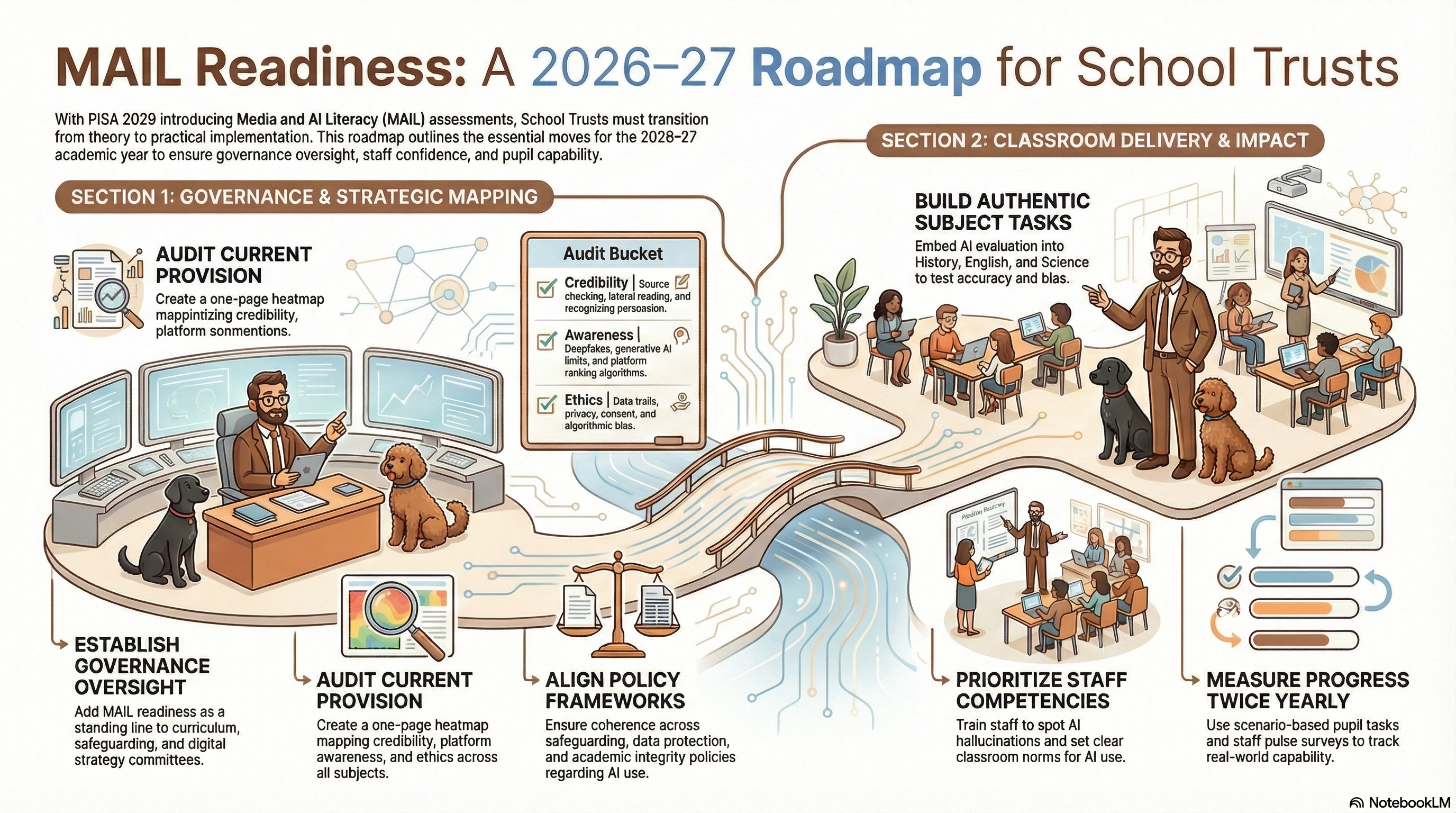
What Trusts should do in 2026–27
A) Set “MAIL readiness” as a governance line of sight
Add a standing line to committee oversight (curriculum/standards + safeguarding + digital strategy):
- Where is media literacy taught (and assessed) across KS3–KS4?
- Where is AI literacy taught (and assessed) across subjects?
- What evidence do we have that pupils can apply these skills, not just repeat slogans?
B) Map current provision quickly (you’ll find gaps)
Do a lightweight audit against three buckets:
- Credibility & evidence (source checking, lateral reading, recognising persuasion)
- Platform & AI awareness (feeds, ranking, deepfakes, generative AI limits)
- Ethics & safety (privacy, consent, bias, manipulation, data trails)
Output: a one-page heatmap by key stage/subject.
C) Build “authentic tasks” into existing subjects
Examples (low workload, high signal):
- History/Geography: evaluate competing claims with source provenance + bias
- English: compare human vs AI-generated summaries; check accuracy + omissions
- Science: scrutinise AI explanations for evidence, uncertainty, and overconfidence
- PSHE/Citizenship: influence techniques, identity, consent, and online participation
D) Sort staff confidence (CPD that doesn’t insult professionals)
Prioritise three staff competencies:
- spotting hallucinations / confident nonsense and teaching pupils to verify
- explaining why AI outputs can be biased (and what to do about it)
- setting classroom norms for AI use that protect learning, not shortcut it
E) Align policy: safeguarding + assessment + acceptable use
Governors should expect coherence across:
- safeguarding (misinformation harms, deepfakes, manipulation, risky contacts)
- data protection and privacy expectations around AI tools
- academic integrity and “when AI is allowed” with clarity by phase/subject
- procurement checks for AI features in EdTech (transparency, data, age gating)
F) Measure progress simply (don’t wait for PISA)
Use internal indicators twice yearly:
- a short scenario-based pupil task (credibility judgement + justification)
- a staff confidence pulse survey (what they can teach confidently)
- incident patterns (misinformation, impersonation, image misuse) to inform PSHE/CPD
Intentionally simple Questions governors could ask (useful in minutes)
- If PISA dropped a simulated “AI + social feed” task into Year 10 tomorrow, how would our pupils cope?
- Where is this taught explicitly (not assumed) and where is it practised?
- Are we building capability… or just writing policies?
- What’s our stance on AI use for learning vs. simple time-saving shortcuts, and do students understand it?
- How do we know disadvantaged students aren’t being left to “figure this out” alone?
Bottom line
MAIL is essentially the OECD saying: critical literacy now includes AI and platform reality. Treat it as a curriculum priority and a governance priority, and you’ll be ahead of the curve well before 2029.
Download a hi-res copy of both infographics from here (1) and (2) in PNG format.

