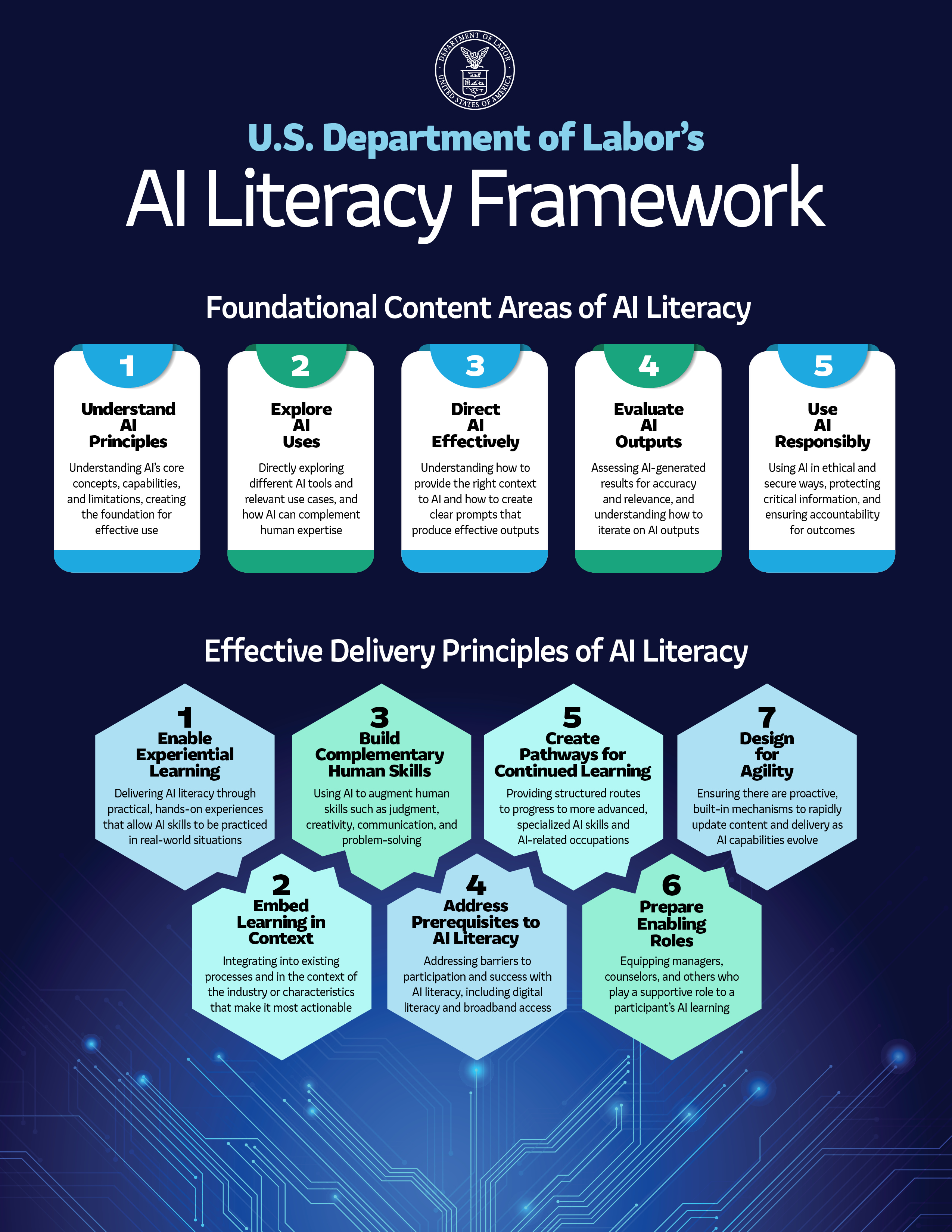
(Download Hi Res copy here – PNG or PDF)
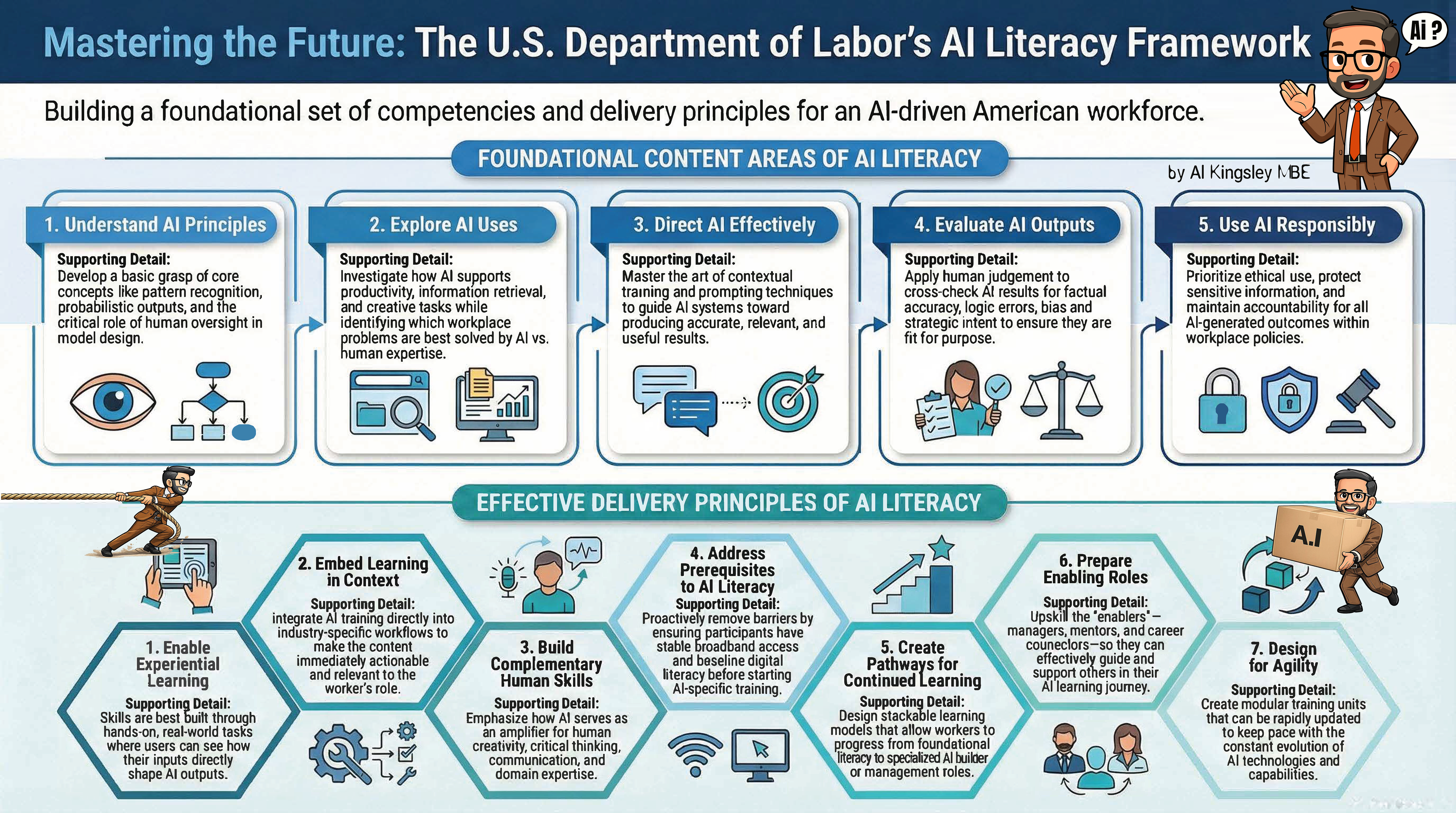
The New AI Literacy Framework: A Guide for Schools and Leaders
The U.S. Department of Labor (DOL) has officially released a new AI Literacy Framework designed to standardize how we prepare the American workforce and students for an economy increasingly driven by artificial intelligence. Published on February 13, 2026, this voluntary guidance provides a common foundation for education providers, employers, and policymakers to design effective AI training programs.
Here is what school leaders and educators need to know about the framework, what it covers, and how to start applying it today.
What is the AI Literacy Framework?
The framework establishes a shared definition of AI literacy: a set of competencies that enable individuals to use and evaluate AI technologies responsibly and effectively. Recognizing that generative AI (like ChatGPT or Gemini) is the most transformative tool in modern workplaces, the framework places a primary emphasis on these technologies. It is designed to be a “starting point” that is agile enough to evolve as technology changes.
What Does It Cover?
The framework is built on two main pillars: Content Areas (what to teach) and Delivery Principles (how to teach it).
The 5 Foundational Content Areas:
1. Understand AI Principles: Teaching the core concepts, such as how models are trained, their reliance on probability, and their limitations (e.g., hallucinations).
2. Explore AI Uses: Familiarizing learners with practical applications like productivity tools, coding assistants, and decision-support systems.
3. Direct AI Effectively: Developing skills in “prompt engineering”—providing the right context and clear instructions to guide AI systems toward useful results.
4. Evaluate AI Outputs: Training students to verify accuracy, spot bias, and apply human judgment rather than accepting AI answers as final authorities.
5. Use AI Responsibly: Instilling ethical habits, such as protecting sensitive data, following policies, and maintaining accountability for AI-generated work.
The 7 Effective Delivery Principles:
1. Enable Experiential Learning: Focus on hands-on practice with real-world tasks rather than abstract theory.
2. Embed Learning in Context: Integrate AI skills into existing subjects and specific job scenarios relevant to the student’s career path.
3. Build Complementary Human Skills: Emphasize that AI augments, rather than replaces, human traits like critical thinking, creativity, and problem-solving.
4. Address Prerequisites: Ensure learners have the necessary digital literacy and internet access to participate.
5. Create Pathways for Continued Learning: Provide routes for students to progress from basic literacy to advanced technical roles.
6. Prepare Enabling Roles: Upskill teachers, counselors, and administrators so they can effectively support students.
7. Design for Agility: Build flexible curricula that can be updated rapidly as AI tools evolve.
Action Steps for School Leaders
The DOL explicitly encourages education providers to use this framework to guide curriculum development and program design. Here are the immediate steps leaders should consider:
- Audit and Integrate: Review your existing curricula to identify where AI literacy modules can be embedded or where current lessons can be enhanced with AI tools.
- Prioritize “Hands-On” Practice: Shift away from theoretical lectures. Give students opportunities to use AI to complete tasks relevant to their field of study, such as drafting marketing copy, debugging code, or analyzing data.
- Train the “Enablers”: Invest in professional development for faculty and career counselors. They are the “enabling roles” who need to feel confident guiding students on how AI impacts career growth and skill requirements.
- Focus on Human Judgment: Design exercises that require students to compare AI outputs with human work. This builds the critical “evaluation” muscle, ensuring students learn to use AI as a support tool rather than a crutch.
- Connect with Employers: Partner with local businesses to understand which specific AI tools and use cases are in demand in your region, ensuring your instruction enhances graduate employability.
I hope this helps, and if it does, please give it a share. You can find the original and full guidance below. I have done my best to use US spelling and grammar throughout. 🙂
Check out the U.S. Department of Labor’s Artificial Intelligence Literacy Framework – Full document.
Link to graphic below – here.